Monday, February 22, 2010

More Adventures in Cape Town...


Now that we are in our fourth week here, the demands on our time by CCS are fewer, so I am planning to spend the whole school day at Blossom Street Primary several times this week. The children in all the groups I am working with need the help so badly.

This past weekend, several of us drove out to the wine country and the town of Stellenbosch. Lovely countryside once we got there, but passing through the Cape Flats was depressing, as usual. Miles upon miles of shacks - of the 40 minute drive, it took us about 30 minutes to travel past the enormous slums of Cape Flats townships: Langa, Athlone, Guguletu, Nyanga, Khayalitsha, etc. These are all communities started when the apartheid government kicked people of color out of the southern suburbs (such as Rosebank - where home base is), the downtown, and the Table Bay areas. Some communities, like District 6, were even leveled (yes, homes which some of these people had lived in for generations). Folks were forcibly moved to the dusty, barren, sandy, windy wastelands of the Cape Flats - where the Cape Town airport also is. So that is why the first sight people see coming into town are these miserable areas where the shacks crowd up one against the other, with outdoor toilets stacked in a row opposite the hovels, which are fenced off from the highway. These shacks are electrified by webs of wires hanging down from the street lights. People spill over the fences and hang out in the grassy strips along the highways. This is also where the children play.

Passing these scenes makes it difficult to enjoy the prettier places I am traveling to visit, especially the opulent vineyard establishments surrounding Stellenbosch. The contrasts are just too great. And Stellenbosch was a very white town!

On Sunday I was privileged to be able to join a group hiking in Orange Kloof (a ravine) on Table Mountain. One can only hike in Orange Kloof with a permit and the elderly mountain man type with whom we hiked had one of these. Actually, it was Clem, the husband of the woman who conducted the walk out from the cable car station on Table Mountain the previous Sunday, when I was up there with Michael Arrowood. Clem picked me up at 7 A.M. and we walked with the others (all South Africans) up a fire road and then up a rocky trail to a green ravine where we saw the day's prize, the glorious red disas (wild orchids) disa uniflora. Smaller blue disas were also spotted along the way, in addition to many proteas, ericas in bloom, and a huge lycopodium, among other treasures. The high point/low point of the day was when the group misunderstood Clem's directions pertaining to the huge water tunnel through the mountain he brought us to. We thought he meant for us to go through the tunnel and the folks at the front went charging on down the 800 steps in the pitch black darkness of the wet, cold tunnel. I, of course, followed - never quite sure I am understanding the South African English anyway, but Clem and one other did not. The steps ended in nothingness (I never got there) and I turned around when the group headed back. All the way up those steps - only this time one could see because of the light at the end of the tunnel, where Clem stood. Apparently he had shouted for us but we never heard because of the sound of the rushing water. There was a wet railing to hold onto in the darkness going down - and no idea just how much of a drop-off it might be if one missed a step. So, needless to say, the way was made in baby steps. Heading back UP, one could see that falling off the staircase would only result in a drop of several feet - not hundreds! What I learned is how important it is for a hike leader to be VERY specific about what he/she says...one never knows how people might be perceiving the words they hear. Apparently, this had never happened to poor Clem before and he has taken many, many groups to the tunnel. He was so worried about us...me, especially, because I was the most senior of the group (excepting him) and a foreigner to boot!

You ask about the weather? Too hot! It was in the mid-90s on Saturday and also warm on Sunday except that in the green ravine where we hiked there was a cloud cover and breezes which kept it cool.

You ask about the pictures? The top two are from the District 6 Museum (those signs are from streets now missing from what was District 6), then there's Clem and the adventure in Orange Kloof - and me emerging from the tunnel of darkness. Sorry those disas are sideways...

Monday, February 15, 2010

Valentine's Day celebration at Blossom Street Primary


Friday was a big fund raiser day - organized by the teachers, not the parents, to supplement federal monies and school fees to help pay for basic school needs. There was a "market" with things to buy, food goodies, drinks, etc. And then there was the contest for Mr. Valentine and Miss Valentine (both lower and upper grades) of Blossom Street Primary School. Those children who entered, by paying a fee, were placed on a "stage" in the interior courtyard formed by plywood boards placed on tables, where they preened and strutted their stuff, in their Valentine Day attire of choice - red and white suggested. We volunteers were the judges, and it wasn't easy. All the children were charming.

Saturday was supposed to be a hike into Skeleton Gorge up Table Mountain with Michael Arrowood, who is spending a few days in Cape Town at the end of his tour - but he didn't make his plane from Jo-burg. So I took the train to Simon's Town to see the penguins again and stood there transfixed for several hours. Much of the courtship behavior is finished and the females are either scratching their nests in the sand or already sitting on their two eggs in very basic nests. The males take their turn as well. Both parents must be watchful or a crafty kelp gull will make off with their eggs. I actually saw this happen - and saw the gull drop the egg on a nearby rock to crack it and devour its contents.

Sunday was the cable car up to the top of Table Mountain with Michael - this time with plenty of time to wander and ponder. Even saw a dassie aka rock hydrax - most closely related, they say, to the elephant. A lovely elderly hiker-type led a guided walk and was very informative. Then on to Kirstenbosch Botanical Gardens, which never seems to amaze me with its varieties of the indigenous fynbos plants of this region - the proteas, the ericas, and the restios (horsetail grasses).

They are keeping us very busy after placement this week. Yesterday we attended a special performance in the township of Gugulethu of singers and dancers who teach about HIV and how to prevent it. Today we went to two museums (the Slave Lodge and the District 6 Museum) and then came back to language lessons. I had decided to switch from isiXhosa to Afrikaans (since I have gone as far as I think I can with isiXhosa) but the Afrikaans teacher didn't arrive today. IsiXhosa is one of South Africa's eleven official languages - and the one mostly spoken by the local blacks. It was thought that it would prove useful for me at school, but all the children understand basic English. Afrikaans, however, is spoken in the staff room. It is the language in which the teachers crack their jokes and I would like to be able to understand it a little. It shares some vocabulary and sounds with German, so I might catch on. IsiXhosa, on the other hand, is very different from anything resembling English, with clicks for C, X, and Q - and different clicks, mind you, from a cluck, to a sound you would make calling a dog, and another you might make calling a horse. Difficult, to say the least. Will tell more about the Slave Lodge and District 6 (one of the areas from which black and coloured South Africans were forcibly removed during Apartheid) another time...

And today it was back to work! But I am having such a wonderful time working with these children.


Wednesday, February 10, 2010

About the volunteer experience so far...


The Cross-Cultural Solutions home base (top picture) in the Rosebank section of Cape Town was built in the late 1800s (as a farmhouse) and is large and airy with high ceilings! I am really psyched this time because, somehow, I have a room all to myself! We get our meals here and they serve a variety of cuisines, some heavily spiced and others stewed and potted. Beef, lamb, chicken, etc., always a fresh salad, good vegetables, no desserts. And they cater to special requests such as vegetarian or low salt.


Breakfast is at 7 A.M. and we are in the vans by 7:45. Even though my trip to the township of Athlone should only take about 15 minutes, I am in the van for an hour each morning because we must first head into the downtown area (before the traffic builds up) to drop off volunteers who work at refugee centers and job training centers. Next we drop off a volunteer at Groote Schuur Hospital (where the world's first heart transplant was done in the 1960s - remember? - I'm the only one in this group who does!). Then we head out to the township areas to drop off the orphanage and day-care folks. Finally, Peter and I are delivered to Blossom Street Primary School. Oh, for those days in Tanzania when I could walk the pot-holed, red dirt roads to Mwereni Primary. and back.

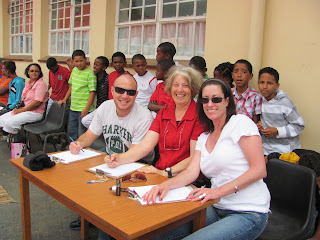
Blossom Street is a well-run school carefully overseen by Mr. Davids who has been principal there (first a teacher) for many years, and his mostly-experienced staff. I am working with a Mrs. Joan Abrahams, who is about my age, rather a strict disciplinarian with a very warm heart. She has almost 35 students - not that large a class by African standards - and teaches the reading and social studies for her class and the other fifth grade class. Since it is still the beginning of the school year here, I spent the first few days assessing the reading abilities of all the fifth graders and am now happily taking them in small groups to another room for instruction every day. They are delightful, well-behaved children and I am enjoying every moment. Mrs. Abrahams and I are getting along very well. Her daughter (along with her grandsons) have been living in New York for the past several years, working on a doctorate at Columbia and one of the first stories she told me was how she (Joan) was subjected to racial profiling in a shop on a visit to her daighter in New York and how totally unexpected and disappointing that was for her. She didn't expect that to happen in the USA after she had suffered so much discrimination in SA over the years. Made me feel awful!


Blossom Street Primary is organized around an interior open courtyard, typical of many African schools, and is much better supplied than Mwereni in Tanzania. There are books, maps, chalk, erasers, posters on the walls, staplers, scissors, a copy machine in the office and all kinds of other things I never saw in Tanzania. Yet the desks are the same double wooden benches and the children labor in the same kind of large, thin, narrowly-ruled composition books you just don't find in the U.S. Blossom has the feel of a 1950s NYC public school; Mwereni felt more turn of the (20th) Century.
More next time...

Tuesday, February 9, 2010

The Other Cape Town...

Cape Town is a city which contains a stunning national park, Table Mountain, in its heart. The city is basically arranged around the mountain and encircles it by about 270 degrees. The real estate on the Table Bay side of the mountain is prime and includes the downtown and the waterfront. On the other side of the mountain, real estate values decrease with altitude until you are in the Cape Flats which is where those former township areas are. A township was, of course, a designated district where blacks or coloureds were mandated to live during apartheid and its inhabitants had to carry passbooks clearly showing who they were, of what race, why and when they were allowed to leave the township (to go to their jobs in the white areas). If you were not carrying your passbook or exceeding the curfew limits, you were thrown in jail or worse. Of course, whites had to carry passbooks too, but their movements were not as curtailed.

The areas in the Cape Flats are still referred to as townships, even though people can come and go freely now. These areas contain some decent housing, but are overwhelmingly populated by very sub-standard housing. Shanties, shacks, former hostels (built for male workers during the mining days) where large numbers of families share communal cooking and eating space and inhabit one room. Really awful. The unemployment rate in South Africa is an overall 38%, but you know which groups have jobs and which have much higher unemployment rates. In the white areas, you see plenty of blacks in the service jobs; in some of the less prosperous inner suburbs, such as where the CCS home base is, you see integrated neighborhoods and people of this "rainbow nation" interacting; and there are many properous black and coloured South Africans - but overwhelmingly the have-nots are black!

For those of you who are wondering, black is an African tribal native (Xhosa, Zulu, etc.), and a coloured is anyone mixed. Coloureds could also include Malaysians and Arabs who were originally brought here as slaves, as were natives of Madagascar. This term is not a slur - it is how people identify themselves - and proudly. Actually, the word native is considered a slur by black folks.

Whites are either of English ancestry or Afrikaaners or both. Afrikaaners are also proud of their "pioneer" heritage. Where I did see lots of wonderful rainbow interaction was at a rugby game at the University of Cape Town. Lots of people I have spoken to have said that it will take some time yet - the next generation perhaps - before true racial harmony exists. I think it might be much longer, because in the meanwhile you have this awful disparity between the way less than 20% of the population thrives and how the majority barely manage to survive.

Meanwhile, at CCS we spent the first days involved in orientation, language lessons, history and HIV lectures. My placement is at a primary school in Athlone, one of the formerly "coloured" townships, and I am enjoying myself immensely. More about that next time.

Friday, February 5, 2010

Final destination - Cape Town!


Cape Town is an incredibly beautiful city but, before you see the beauty, you see the extreme poverty of township housing on the way from the airport to downtown. Shacks, often little more than pieces of corrugated metal hammered together, line the highway into downtown. We were told that, in an effort to clean things up for the World Cup, the government has built some public housing, and sure enough, soon we passed a section of small, neat, stuccoed cement block houses lining the road, behind which were more shacks.


Our hotel was in Seapoint, on the other side of Table Mountain, one block from Table Bay. Quite nice, but we were told not to go walking at night. Daytime walks along the water were lovely, though. During my last days with the Overseas Adventure Travel group, we had a city tour and visited the Victoria and Alfred Waterfront, saw the Moslem part of the city, and had dinner with a coloured family (seems hard to write but here it is PC) in their home in one of the townships. Renee and I did a "must see" trip to Robben Island where we viewed the cell in which Nelson Mandela spent 18 years of his life. On Saturday, January 30, the day I was due at Cross Cultural Solutions, we took the cable car up Table Mountain for spectacular views and we drove along the coastline out to Cape Point, which is not where the Atlantic and Indian oceans meet! The best part about the day was the visit to the penguin colony where we saw African pengins enacting their courtship rituals, braying and even mating. During my time here, I definitely plan to go back to the top of Table Mountain and also to the penguin colony - I could have spent a half day at each, instead of just a half hour. I left the group as they were entering Kirstenbosch Gardens back in town because I knew I would have plenty of time there for a much longer visit (probably several visits) and because the gardens were a short cab ride from the CCS home base which would be my abode for the next five weeks.

So here I am, living with 19 people younger than me (some by a lot), making this very stratified city my home for the next 5 weeks. Just another challenge....

Thursday, February 4, 2010

On to Lesotho...


The next day our conveyance was a 4x4 vehicle which took us up another precipitous and bumpy road to Sani Pass in the mist at about 10,000 feet and into the independent kingdom of Lesotho, crossing a border out of South Africa again. The highlands of Lesotho have an alpine feeling, as did the restaurant in which we ate lunch, dubbed "the highest pub in Africa." Most interesting was a visit to a wild and remote-feeling Basuto village where people live much like they did centuries ago, yet raising a white flag if they have bread (baked over cow dung coals) or a red flag if they have meat (from their herds of goats) for sale to the odd traveler who ventures up this road.

Returning to lower elevations at our hotel in Himeville, I hiked out to the top of a majestic waterfall, its flow draining from the spectacular highlands we had just visited.

On to KwaZulu-Natal Province...


Continuing south through lush, green countryside we crossed the border back into South Africa and headed into Zululand. Shaka, the great and terror-inspiring Zulu warrior-king, led the only significant battle in which the British were defeated (1879). He also is known for things like slaughtering his own children and ordered all old mothers in his kingdom killed when his own mother died so that his subjects should share his pain. He came to power by assassinating his brother; in turn, one of his other brothers assassinated him.

Our next stop was Simunye Lodge, which was a tractor-driven ride down from the plateau on a long, bumpy, precipitous road into a green canyon -- and then we trudged in the heat (about 80+ degrees) across a river on a footbridge and up a hill right next to a Zulu Village. Our lodgings were in a rondavel - a bit less rustic than the real thing, though. Of course, we met the chief and were entertained with singing and dancing and demonstrations of battle lore. The second day we had some time to wander around and to relax by a very unique pool built into the canyon wall. I actually had the first massage of my life there - the equivalent of $14 for an hour's full-body massage!

Leaving Simunye the next day, we had the same tractor ride uphill. Continuing south on our van, we passed more rustic-looking homesteads, but also large sugar-cane plantations and huge tree farms (pine, eucalyptus). We drove into Durban, which has the largest Indian population outside India, and visited a spice market. We had hoped to have lunch on the Indian Ocean waterfront, but it was all torn up in preparation for the 2010 World Cup. (Lots of road work going on all over South Africa, as well, to get ready for this event.) I wasn't unhappy when we headed back out into the green countryside, west toward the southern Drakensberg mountains, the region in which Cry, The Beloved Country was set.